
Blog
-
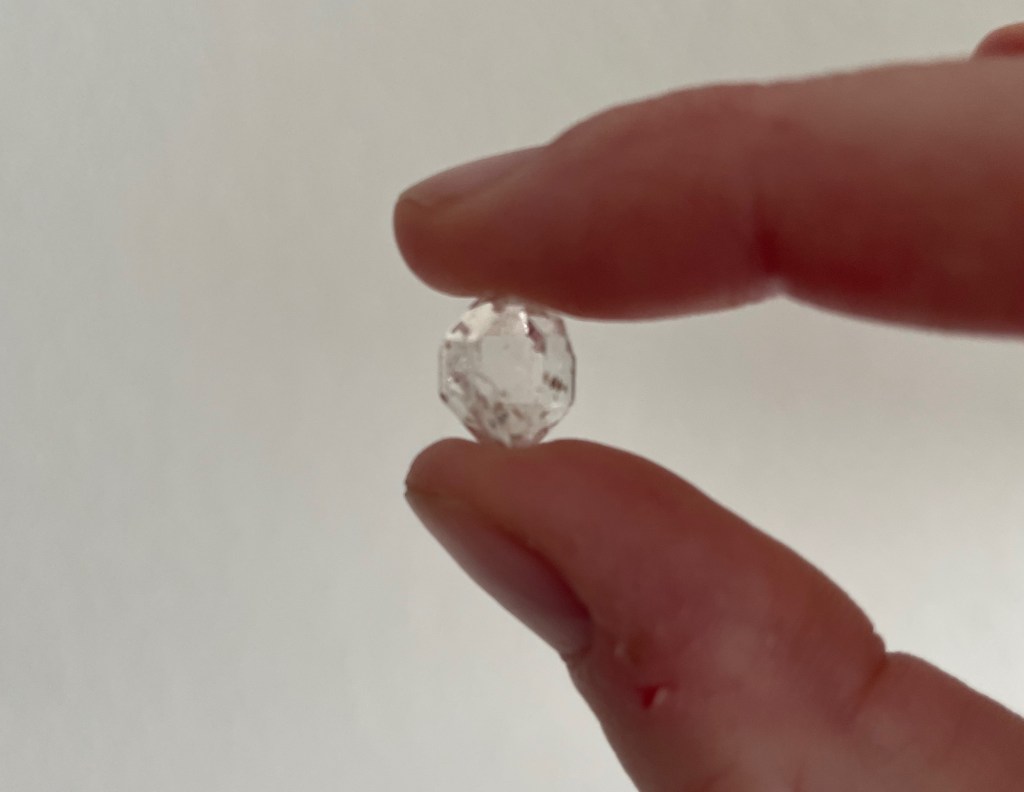
Diamond Mining in Upstate New York
Last week I had the opportunity to go on a road trip with my father through upstate New York. Both of us being scientists, our interest lay less in the scenery and tourist attractions, and more in what lay beneath our feet. Our first stop on the trip was the small town of Herkimer, where one could dig through 500-million year old dolostones1 to find the elusive Herkimer Diamonds.
The clear, doubly terminated crystals found in Herkimer are not true diamonds. Diamonds are composed entirely of the element carbon, the same material as can be found in the graphite of any No. 2 pencil. They form beneath the Earth’s crust, under immense pressure and heat, and are brought to the surface through a rare type of volcanic eruption. The extreme conditions under which they form makes diamonds the hardest natural substance in the universe, very unlike their carbonic cousin, graphite.
Herkimer diamonds are, in reality, made of a much more common substance, though their method of formation is no less unique. The chemical formula of these “diamonds” is SiO2 (silica), known more commonly in its crystalline form as quartz. Quartz is the most common mineral in the Earth’s crust, and forms naturally in granite and other igneous rocks. Quartz is also found in sedimentary rocks such as sandstone. It is not, however, a typical component of dolostone, which makes up the bedrock of much of New York State, and Herkimer in particular. So where did this quartz come from, and why does it form such unique crystals, which are found nowhere else on Earth?
To answer this question, we must backtrack 500 million years, when the Little Falls Dolostone was first deposited. At the time, Central New York was underwater, a tropical, shallow sea2. It was in seas such as these that life began to graduate from simple, soft bodied organisms into more recognizable forms. Most of the life in these early seas resembled modern phytoplankton and corals, and built their bodies out of calcium carbonate (CaCO3). When these organisms died, their calcareous bodies sank to the shallow sea floor, where they would mix with sand and be compressed into limestone.

An artist’s impression of the positions of the continents during the Cambrian Period. The Laurentian continent sits on top of what is known as North America today.
Image Credit: Wikipedia: CambrianOnce deposited, the limestone then underwent a period of metamorphism, likely when the Potsdam Sea began closing at the end of the Cambrian Period. Metamorphism subjected rocks to intense heat and pressure, chemically altering them in the process. Magnesium entered the crystalline structure of the limestone to form calcium magnesium carbonate, or CaMg(CO3). The resulting rock is harder than its limestone cousin, but was still subject to erosion by acid rain. Over time, the rock filled with cracks and pockets, the perfect place for crystals to form.
As the Iapetus Ocean continued to close, hot, mineral rich water filled the pores and pockets of the rock. This silica soup was the perfect recipe to form the clear, doubly terminated crystals we find today. The crystals grew slowly, free from impurities that might affect their clarity or color. The ample space within the rock pockets allowed the crystals to form their distinct, doubly terminated shape.

A large example of a Herkimer Diamond. Image Credit: GeologyIn: Herkimer Diamond: What is It, Where to Find It
Rocks of this age are quite hard to find at Earth’s surface, most being buried under hundreds of millions of years worth of sediment. Fortunately, Earth is a very dynamic planet, with many types of erosive processes that can shave away these many layers. In New York’s case, it was the invasion of glaciers that rolled through several times in the past 2.5 million years1, tearing through the rocks like a bulldozer on their way south. The constant removal of the overlying rock exposed the Little Falls Formation to the sky, where curious humans could dig up these remarkable crystals and (incorrectly) call them diamonds. And if you visit the little town of Herkimer, and you go digging, you may very well find a piece of Earth’s ancient history of your very own.

Image Credit: TripAdvisor
Citations:
- Donald H. Zenger; Definition of Type Little Falls Dolostone (Late Cambrian), East-Central New York: GEOLOGIC NOTES. AAPG Bulletin 1976;; 60 (9): 1570–1575. doi: https://doi.org/10.1306/C1EA38AC-16C9-11D7-8645000102C1865D
- USGS; Geology of the New York Region. https://www.usgs.gov/geology-and-ecology-of-national-parks/geology-new-york-region
April 28, 2025
 Earth Science Stories